
Generational Love for Church Fuels Campaign

Share
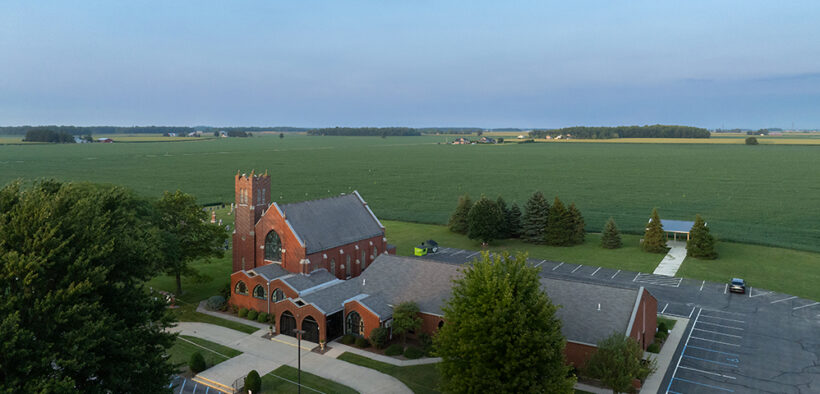
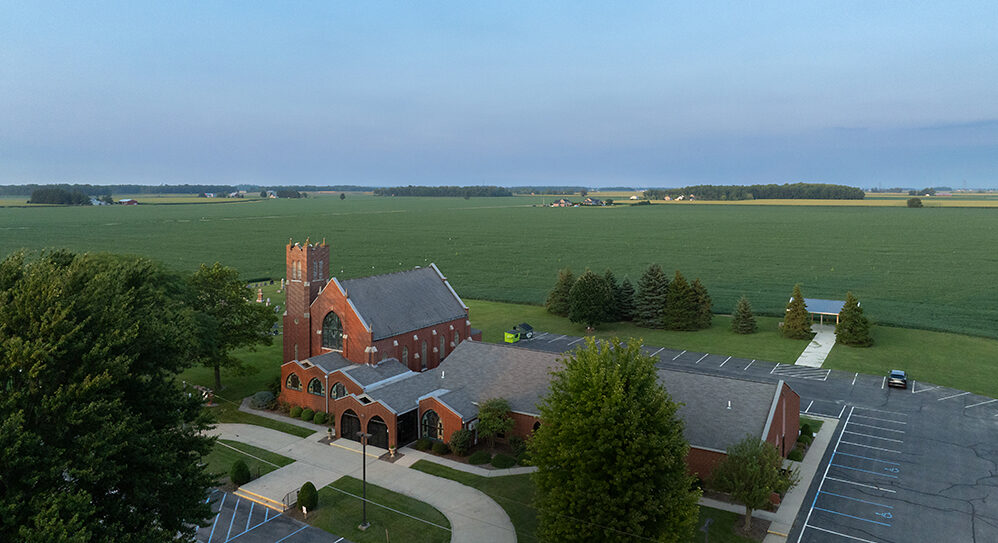
St. Paul Lutheran Church needed to update the church’s accessibility standards. Then congregational support nearly doubled expectations.
Out on Gar Creek in Indiana, there’s a brick church with a century-old sanctuary, a 45-year-old fellowship hall and a proportionately ambitious renovation goal. Who would have thought it would be possible for the church to reach it?
The people of this congregation shocked themselves and us at Lutheran Church Extension Fund (LCEF) at the same time.
The people at St. Paul Lutheran Church in New Haven had done, in their words, “the most Gar Creek” thing you could imagine: they banded together to support a church that needed help.
Why this project—and why now?
St. Paul was originally established in 1880, and in 1983, they expanded with a larger narthex and fellowship area. After nearly 45 years of use, the folks at the church had concluded: maybe they didn’t dream big enough when that narthex was constructed.
 SnapShot
THE GOAL
St. Paul Lutheran Church needed a renovation for increased sanctuary accessibility and safety.
THE CHALLENGE
The project was quoted at $3.3 million, but LCEF’s projected commitment goal was $900,000. Instead, St. Paul set their own commitment goal of $2.2 million.
THE SUCCESS
A culture-appropriate campaign revealed compassionate giving that exceeded the church’s (and LCEF’s) expectations.
“Imagine having mobility issues and, once you hit the stairs, you realize you can’t make it all the way up.”
—Pastor Michael Blodgett
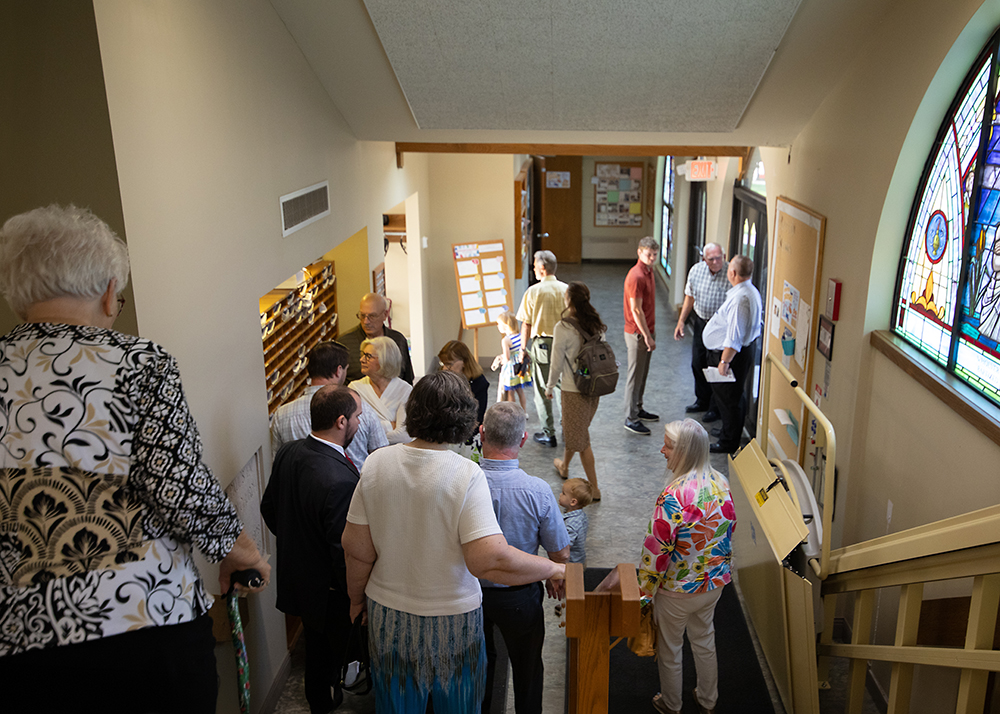
As the congregation numbers continue to swell, the crowd at fellowship time after service overflowed beyond the church doors. It’s a pleasant setting in warmer months—but not so much during the winter. Then, even if people squeezed inside, the narthex entrance was prone to leaking snow and rain into the building.
After considering protection from the elements, the final step to creating a safe and accessible church and sanctuary was an elevator.
While the church had a chair lift in place, parishioners weren’t comfortable using it. Mike Koeneman, campaign manager for the congregation, noted, “We have some pride. We don’t necessarily like to show that we aren’t able to do those simple tasks anymore.”
Apart from the lift, a brief flight of stairs was the only other way into the sanctuary. For those in an aging congregation, stairs are not easy—or even remotely possible—for everyone. Pastor Michael Blodgett, who has been leading St. Paul for over 14 years, had witnessed congregants confront physical limitations firsthand. He said, “Imagine having mobility issues and, once you hit the stairs, you realize you can’t make it all the way up the stairs. That’s absolutely heartbreaking … halfway up to church and you realize you’re not going to make it all the way up and just turn around.”
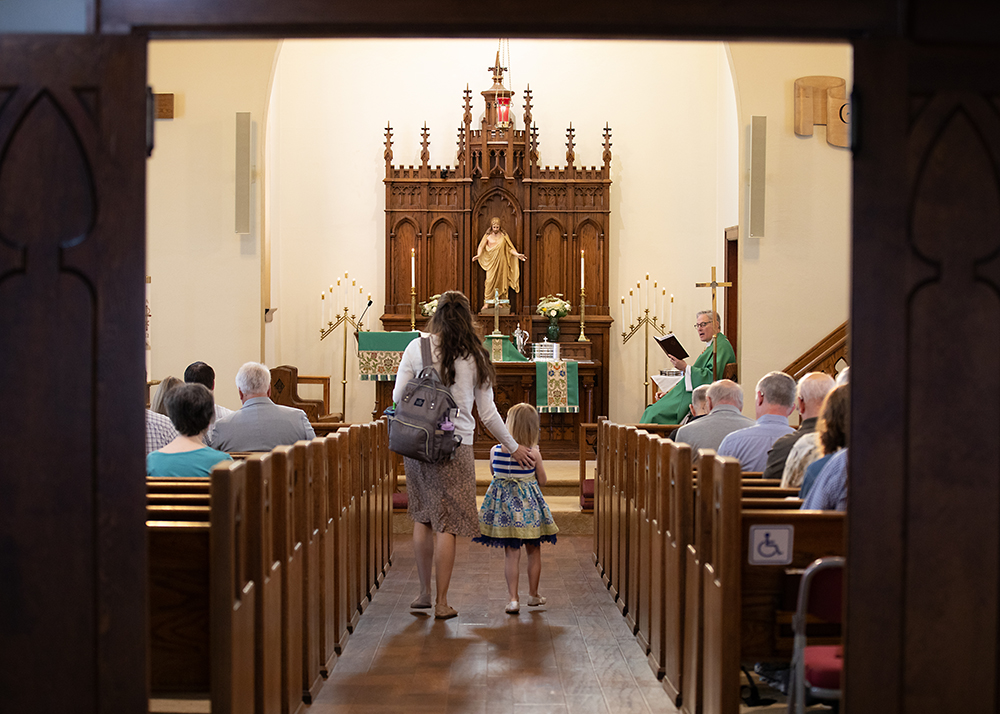
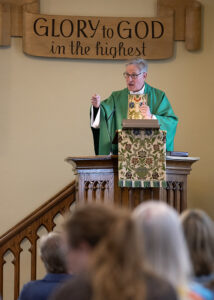
Pastor Michael Blodgett shares a sermon during a Sunday morning service.
Congregational voice and culture prevail
This time around, the church brought in an architect to study the building and hired LCEF to shepherd a Ministry Expansion Campaign.
The architect’s full project quote ended up at $3.3 million.
To reach that project cost, at least $2.2 million would need to be contributed by the church and combined with the church’s grants and preexisting savings.
When LCEF recommended a $900,000 target in congregational commitment towards the $3.3 million project cost, leadership at the church respectfully declined and proposed their own commitment goal: $2.2 million.
Rev. John Glover, Vice President of Ministry Solutions, integrated the church’s objective into the campaign rather than pushing his own. He said, “My job is to help facilitate so the congregation can have a family conversation so that the campaign can be inspirationally framed … They’re the heroes of the story.”
Here’s the twist: the people at St. Paul blew that estimate out of the water.
FAST FACT: A leadership commitment event is a gathering of leaders in a congregation who are invited to step up and be the first to commit to the Ministry Expansion Campaign. Their commitments at this event help motivate and inspire other members of the congregation to commit to the campaign as well.
Campaign strategy tools and successes
The team at St. Paul collaborated with Glover to accomplish their ambitious project goals. After working closely with Glover to discover the clarity behind their “why” for the project and campaign, they recruited an entire team of volunteers who could use their God-given gifts in well-suited roles. They held public forums, created informational documents, managed their budget and more.
Among the tools St. Paul used to see their project through to completion, there were three particular strategies that became integral to the final outcome of their campaign: cottage visits, gifts in kind and a leadership commitment event.
Before the commitment phase, the campaign team scheduled in-home cottage visits (sometimes called lead gift visits) with the top third of givers in the congregation to share the goals of the project. At this stage, Glover advised the church team: “Just go and tell the story about the ministry work that you want to get done” and the rest will come.
Pastor Blodgett, supported by church elders, implemented this approach, which already aligned with his practice. He noted, “My preaching is never about money … You present the need and the people respond joyfully.” During visits, he outlined the history of the congregation, shared pictures of that story and illuminated what the future of St. Paul could be like, with a weather-safe narthex and a fully accessible sanctuary.
Cottage visit discussions also included a mention of another traditional way to support project goals without directly contributing money: gifts in kind.
The people at St. Paul have a longstanding farming heritage. With the option to give in kind, a congregant could donate a portion of their harvest as a campaign contribution. This is an established—though sometimes overlooked—approach to allowing congregants to utilize all manner of gifts from God to support the church.
Then, at the end of each cottage visit, families were left with a no-obligation commitment card and an invitation to a leadership commitment event to be held at a later date.
The cottage visits also held deep value even beyond campaign work. Pastor Blodgett recalled, “They became an opportunity for pastoral care, too.”
Cottage visits continued through the weeks leading up to the leadership commitment event in December 2025.
The big reveal on commitment night
At the event, congregation members who had participated in cottage visits were invited to enjoy food and refreshments at a local restaurant. There, they could bring in their completed pledge cards and be the first to hear about the final commitment total.
The final lead gift total: $1,591,640.
That’s 177% of LCEF’s anticipated $900,000 goal.
The generosity of congregational leaders inspired others to give, too. With funding progressing towards their goal—and a loan through LCEF to close the funding gap to their $2.2 million commitment goal—the groundbreaking on the project at St. Paul just took place in fall of this year.
Glover marveled at the “multi-generational love of this church.” They had pulled together and “followed the process. They didn’t eliminate any steps. They did it their way.”
As construction for St. Paul Lutheran Church continues, the people of the church will continue to develop even more ways share God’s love with their community. In other words, as Koeneman put it, “This is a very compassionate and giving congregation … If you would come here, you would see how welcoming the congregation is and how concerned they are about all those who enter, even if they’re not members. It is a family of God.”
And there’s nothing more Gar Creek than that.
Learn more about custom campaign solutions for your ministry at lcef.org/process.

